
National Day Events
UAE National Day Event Management in Dubai & the UAE
A guide to planning UAE National Day celebrations in Dubai — covering heritage village concepts, cultural activations, traditional hospitality, AV and décor production, and the operational planning decisions that determine how the occasion lands for your guests.
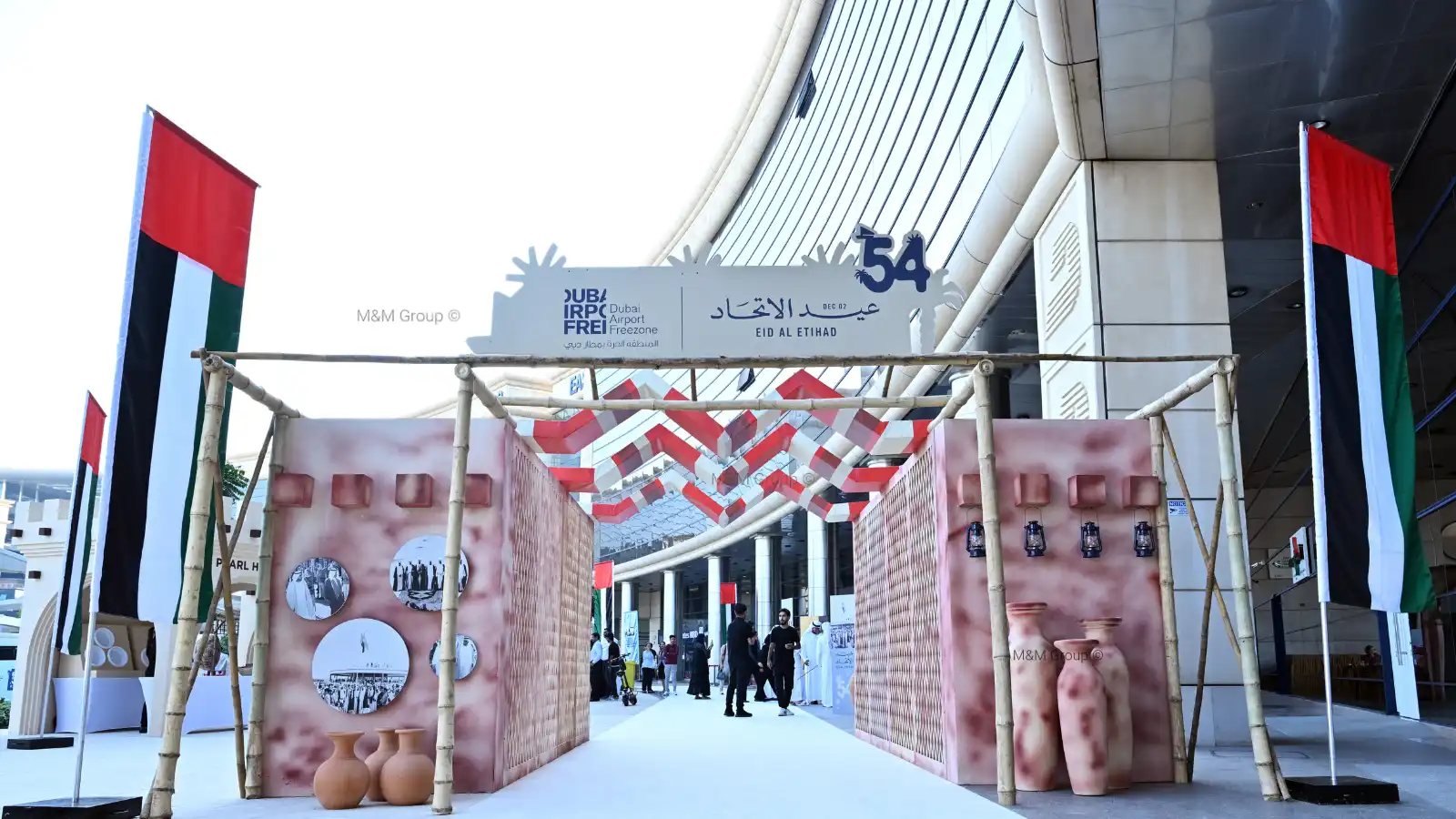
UAE National Day falls on 2 December each year — a fixed point in the UAE calendar that requires planning well in advance, particularly for organisations that want to deliver a meaningful guest experience rather than a standard corporate gathering. This guide covers the key planning decisions for UAE National Day event management in Dubai and across the UAE: heritage concept, cultural activations, entertainment programming, traditional hospitality, spatial design, and operational coordination.
Who plans UAE National Day celebrations in Dubai
A broad range of organisations plan UAE National Day events in Dubai each year. Corporate companies typically hold internal celebrations for employees and guests — either at their own premises or at an offsite venue. Government and semi-government entities mark the occasion with events for staff and stakeholders. Community developers and malls organise celebrations for residents and visitors. Schools and universities mark the day with campus events for students and families.
The scale, budget, and production approach differ significantly across these formats, but the core planning considerations are consistent: an early decision on format and concept, a clear understanding of what the cultural moment requires, and coordinated delivery across venue, production, activations, entertainment, hospitality, and operational logistics.
UAE National Day event planning in Dubai should begin at least three to four months before 2 December — earlier for large-scale or outdoor events — given competition for venues, licensed suppliers, and authority permit capacity in the weeks leading up to the national holiday.
Heritage village concepts and cultural zones
One of the most established formats for UAE National Day events is the heritage village — a themed event environment structured around Emirati cultural references. Heritage village concepts organise the event space into defined zones drawing on UAE traditions: an areesh tent, traditional seating areas, a dukkān display, cultural cooking stations, and hospitality stations serving Arabic coffee, Karak tea, and traditional Emirati beverages.
The heritage village format works for both indoor and outdoor settings. Indoor corporate events in Dubai typically use a sectioned floor layout, with zones created through temporary structures, fabric, décor, and lighting. Outdoor settings allow larger footprints and additional structural scope.
A well-designed heritage village uses the physical environment to guide guests through the experience — arrival at a branded entry element, movement through cultural activity zones, access to hospitality, and engagement with live entertainment and interactive activations — rather than presenting individual elements as unconnected stations scattered across the venue.
Traditional Emirati activities and interactive activations
The activity and activation layer of a UAE National Day celebration determines how guests engage with the cultural content of the event, beyond the visual environment. Traditional Emirati activities that commonly feature in National Day programs include:
- Henna art stations — a professional henna artist available for guests throughout the event, typically set within an areesh tent cultural area
- Falcon display and photo opportunity — a significant UAE heritage element; guests can hold and photograph the falcon as a cultural moment within the celebration
- Traditional games — Camel Lasso Toss, Soft Archery, Gargoor Pearl Shooting, Ring Toss, Pearl Harvest, and Date Smash are common formats, structured within heritage-styled game booth builds
- Live craft workshops — calligraphy, pottery, bukhoor making, clay medkhan making, and charm bracelet stations provide hands-on cultural engagement moments
- Heritage photography setups — areesh-framed seating areas, traditional backdrop displays, UAE-themed selfie structures, and branded photo studios with printing
Each activation requires specific supplier coordination: professional falcon handlers, qualified henna artists, trained craft workshop facilitators, and event staff to manage guest flow through activity zones during peak attendance windows.
Cultural performances and entertainment
Live entertainment at UAE National Day celebrations draws on traditional Emirati music and performance forms. Ayallah — a traditional group performance combining singing and rhythmic movement — is one of the most common live performance elements for National Day events in Dubai. Harbiya is another traditional entertainment form featured in National Day programs.
Beyond traditional performance, entertainment programs for National Day events often include:
- Oud and guitar duos — pairing the Emirati heritage instrument with a complementary contemporary sound for ambient and live-set performance
- National anthem performance — a formal cultural moment appropriate for the beginning or mid-point of the event program
- Live sketch artists — capturing guest portraits in real time as a personalised cultural take-home
Entertainment scheduling at a National Day event requires coordination with venue access, hospitality service windows, and guest arrival patterns. Live performance moments should be timed so they are accessible to the widest portion of the guest group — not overlapping with peak F&B service or coinciding with restricted-access periods.
Live cooking stations and Emirati hospitality
Food and hospitality are central to UAE culture and should be treated as a substantive planning consideration, not a logistical afterthought. Traditional live cooking stations that commonly feature in UAE National Day events in Dubai include:
- Luqaimat — traditional Emirati sweet dumplings, typically prepared in front of guests with a live cooking setup
- Regag — thin Emirati flatbread cooked on a large hot plate, visible to guests as part of the cultural food experience
- Chebab — traditional Emirati pancakes prepared and served at the station
- Halwa — traditional Emirati sweet that requires two to three hours of preparation before serving; should be planned as an early setup element with appropriate lead time built into the event schedule
- Omani halwa — prepared and served from an open cooking station as a live culinary activation
Traditional beverage hospitality at UAE National Day events typically includes Arabic coffee (qahwa), saffron milk tea, Karak tea, and Suleimani tea — served from dedicated stations or as a roaming service across the event environment.
A traditional areesh coffee shop structure creates a focal hospitality zone that functions as a natural gathering and dwell area throughout the event. The dukkān — a traditional Emirati shop display with heritage snacks, spices, and artisanal items — adds a sensory and visual reference to Emirati commercial heritage within the celebration environment.
Planning live cooking activations requires coordination with food safety requirements and, for outdoor events, municipality F&B approvals. Cooking station positioning also affects guest flow — high-dwell areas should not create bottlenecks at the intersection of hospitality and circulation zones.
Stage, AV, décor, and guest-flow planning
The production layer of UAE National Day event management — structures, branding, AV, lighting, signage, and guest-flow design — has a direct effect on how the occasion feels for guests. National Day visual identity typically draws on UAE flag colours (red, green, white, and black), heritage pattern language, and the specific edition of the national celebration.
Production elements common to UAE National Day events in Dubai:
- Branded entrance arch or tunnel entrance — establishing the celebration identity from the point of arrival, before guests enter the main event environment
- Backdrop structures — Spirit of the Union-themed backdrops, UAE skyline frames, national flag displays, and thematic large-format printed graphics
- Branded pillar treatments and wall graphics — maintaining visual identity consistency throughout the venue footprint
- Areesh tent structures — traditional palm-frond construction used for hospitality zones, henna areas, cooking stations, and cultural seating
- LED screens — for entertainment support, ambient content, and digital activation moments
- Sound system — covering the full event footprint, with consideration for hospitality zones where lower volume levels support conversation
- Decorative layers — UAE flags, heritage lanterns, marine décor references (boat, gargoor net, pearl display), clay pots, and traditional weaving elements
Each structural element must be planned against the specific venue: ceiling height, floor load capacity, rigging points, power availability, and build-and-break access windows all affect what is achievable within a given production budget. Venue site visits and technical assessments should take place early in the planning process — not at the point when fabrication is already underway.
Guest-flow design — how guests move between arrival, heritage zones, hospitality, entertainment, and activity areas — is an operational planning decision that affects both the guest experience and the practical management of the event. High-traffic intersections require spatial planning; activation zones that draw queues must be positioned so they do not block circulation to other areas of the event.
Corporate and government celebration formats
Corporate UAE National Day celebrations in Dubai most commonly take one of two forms: an internal event at company premises, or an externally hosted event at a selected venue. Internal events at corporate headquarters or campuses allow more control over guest flow and environment design, but are constrained by the existing spatial characteristics of the space. Externally hosted events expand format options but require early venue commitment — competition for suitable Dubai venues around 2 December is consistent and early booking is essential.
Government and semi-government National Day celebrations in Dubai typically involve larger guest numbers, more complex permit requirements, and a higher emphasis on formal elements — national anthem performance, formal arrival sequences, dignitaries management — within the overall event program. Authority approvals for large-scale government events may involve multiple bodies: DCTCM, Dubai Police, Dubai Civil Defence, and municipality coordination, depending on the event’s public-facing nature and venue.
Community and residential developer celebrations, planned for wider public audiences, involve crowd management planning, extended operating hours, and entertainment programs scaled to a diverse visitor profile across the full event window.
Operational planning and supplier coordination
UAE National Day events require coordination across a wide supplier base: structure and fabrication contractors, AV and lighting technicians, traditional entertainment performers, food and beverage operators, activity facilitators, security, photography, and operational staff.
Key operational planning decisions for UAE National Day events in Dubai:
- Permit timeline — authority applications should be submitted in parallel with production planning, not after production decisions are made; permit timelines vary by event type and authority involved
- Venue build and break windows — access periods around 2 December are often shortened by competing events; confirming access windows before finalising production scope prevents build-time conflicts
- Live cooking setup timelines — halwa requires two to three hours before serving; cooking stations must be set up and F&B approvals confirmed well before event opening
- Guest flow design — how guests move through heritage zones, hospitality, entertainment, and activity areas without congestion points
- Weather contingency — outdoor events in early December require contingency planning even in Dubai’s cooler season; wind, humidity, and occasional rain can affect outdoor production elements
M&M Group has produced UAE National Day celebrations across multiple formats and environments in Dubai and across the UAE, including events for flydubai’s 51st UAE National Day at flydubai HQ, AW Rostamani Group’s 52nd UAE National Day celebration at their Dubai headquarters, and Dubai Airport Freezone’s 54th UAE National Day at the DAFZ Walkway.
For broader event planning considerations in Dubai, see the event planning in Dubai guide. For context on how event production scope is structured, see understanding event production scope.
For UAE National Day event management and production services, see event management in Dubai, event production in Dubai, and brand activation in Dubai.
Event Planning
Event Planning in Dubai — What You Need to Know Before You Brief
A practical guide to event planning in Dubai — covering permits, venue selection, delivery timelines…
Event Production
Understanding Event Production Scope — What Production Actually Covers
Event production is one of the most commonly misunderstood terms in the industry. This article expla…